When Waymo's robotaxis started operating without safety drivers in Phoenix, they represented Level 4 autonomous driving—vehicles that can handle the entire driving task in specific conditions without human intervention. But the automotive industry has long recognized that the ultimate goal is Level 5: full automation that works anywhere, anytime, without geographic or weather restrictions.
We're seeing the same progression in analytics AI, but most data teams don't realize they're stuck in the equivalent of Level 2 "partial automation"—constantly hands-on-wheel, ready to take control when the AI inevitably gets confused.
In the spring of 2023, I watched a senior data scientist at a Fortune 500 company spend forty-seven minutes trying to get ChatGPT to write a query that would tell him how many customers churned last quarter. The first attempt gave him a SUM instead of a COUNT. The second hallucinated a table called customer_lifecycle_events that didn't exist. The third returned a syntactically perfect query that would have run beautifully—in MySQL, not the Snowflake instance he was actually using.
By attempt number twelve, he'd successfully recreated the analysis he could have written himself in about three minutes.
"This is incredible," he told me afterward. "AI is going to change everything."
He wasn't wrong about the second part. But he was operating a Level 2 system while thinking he was glimpsing Level 5. And that gap—between what AI analytics promises and what it actually delivers today—is costing companies millions in productivity and opportunity costs.
The five levels of analytical AI adoption
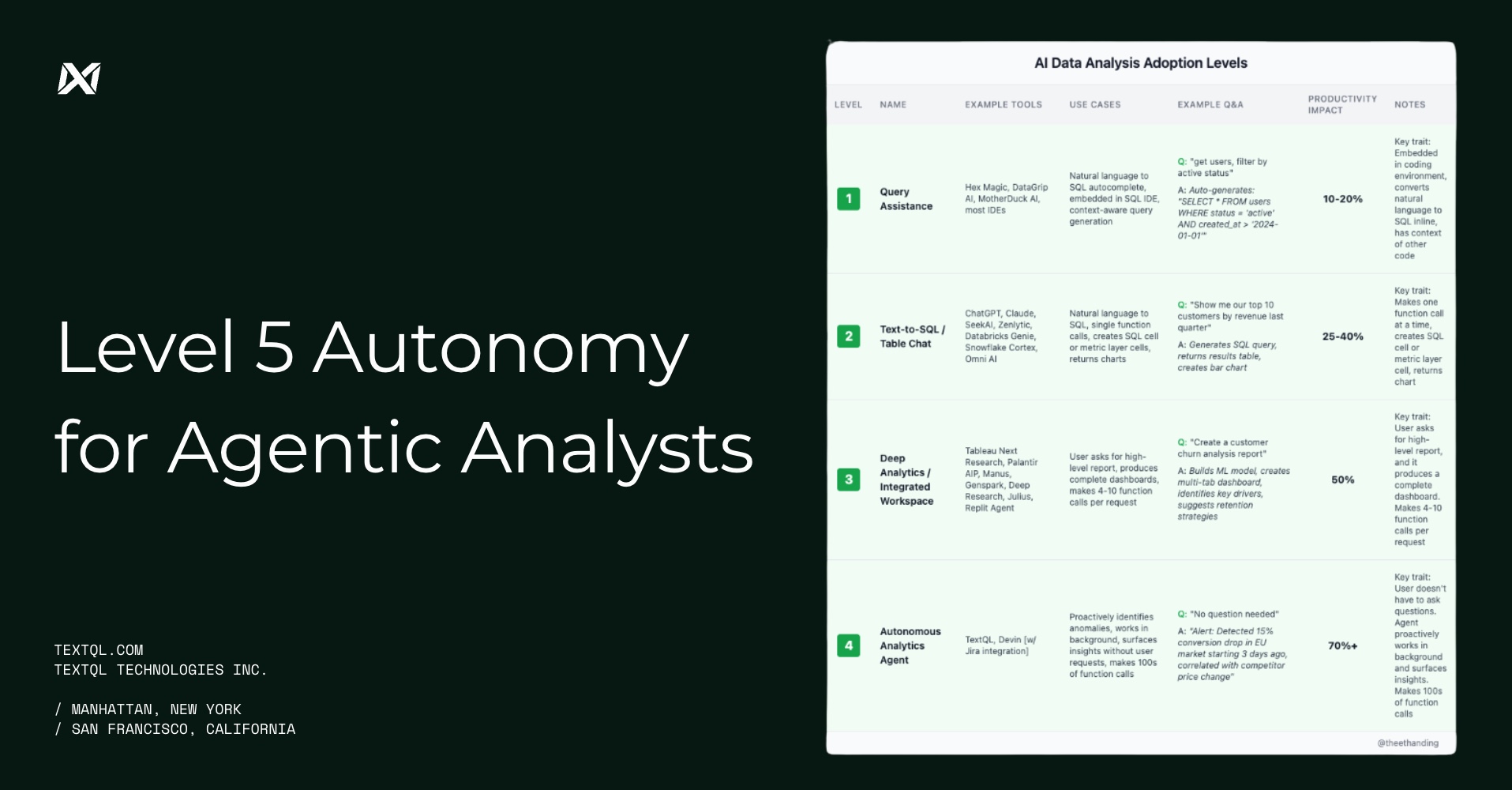
Just like the automotive industry's clear progression from driver assistance (Level 1) to full autonomy (Level 5), analytics AI follows a predictable maturity curve. But there's a massive gap between "ChatGPT can sometimes write working SQL" (Level 2) and "AI discovers business opportunities you never knew existed" (Level 5)—and that gap is bridged by understanding where your team actually sits on the adoption spectrum.
Level 1: Query Assistance (10-20% productivity gain)
- Tools: Hex Magic, DataGrip AI, MotherDuck AI, most IDEs
- What it does: Autocompletes SQL, suggests corrections, embeds context awareness
- Who uses it: Everyone, eventually
- Key insight: It's embedded in your coding environment, converts natural language to SQL inline
This is copilot for data work. ChatGPT can generate complex SQL queries quickly, enabling rapid data retrieval and analysis, but Level 1 tools are more like having a very good autocomplete that understands your schema. They live in your IDE, they know your table structures, and they save you from typing out long CASE statements.
Level 2: Text-to-SQL / Table Chat (25-40% productivity gain)
- Tools: ChatGPT, Claude, SeekAI, Zenlytic, Databricks Genie, Snowflake Cortex
- What it does: Natural language to SQL, single function calls, creates SQL or metric layer cells, returns charts
- Who uses it: Most teams experimenting with AI today
- Key insight: Makes one function call at a time, creates SQL cell or metric layer cell, returns chart
This is where that Fortune 500 data scientist was stuck. You ask a question, the AI writes a query, you run it, you get results. When it works, it feels magical. AI tools do not suffer from fatigue, ensuring consistent performance over extended periods. But when it doesn't—and there are a lot of issues these models face—you're debugging someone else's code.
Level 3: Deep Analytics / Integrated Workspace (50% productivity gain)
- Tools: Tableau Next Research, Palantir AIP, Manus, Genspark, Deep Research, Julius, Replit Agent
- What it does: User asks for high-level report, produces complete dashboards, makes 4-10 function calls per request
- Who uses it: Teams that have moved beyond one-off queries
- Key insight: Builds ML models, creates multi-tab dashboards, identifies key drivers, suggests retention strategies
This is where AI starts to feel less like a better autocomplete and more like a junior analyst. You can ask for a "customer churn analysis report" and get back a multi-page document with segmentation, predictive modeling, and actionable recommendations. The AI doesn't just write queries—it builds complete analytical workflows.
Level 4: Autonomous Analytics Agent (70%+ productivity gain)
- Tools: TextQL, Devin, various research agents
- What it does: Proactively identifies anomalies, works in background, surfaces insights without user requests, makes hundreds of function calls
- Who uses it: Almost nobody, yet
- Key insight: User doesn't have to ask questions; agent proactively works in background and surfaces insights
Level 4 is where AI truly becomes autonomous within defined boundaries. Instead of you asking "why did our conversion rate drop?" the AI tells you "Alert: Detected 15% conversion drop in EU market starting 3 days ago, correlated with competitor price change." But it still operates within predefined analytical frameworks and business contexts.
Level 5: Autonomous Data Science Agent (90%+ productivity transformation)
- Tools: Hypothetical future systems, early research prototypes
- What it does: Discovers entirely new business opportunities, creates novel analytical frameworks, operates across unlimited business contexts
- Who uses it: Nobody yet—this is the theoretical endpoint
- Key insight: AI doesn't just answer questions or identify problems—it discovers opportunities and strategies humans wouldn't have conceived
Level 5 represents the theoretical endpoint: an AI that doesn't just analyze your business but fundamentally understands it better than you do. It identifies new market opportunities, discovers hidden customer segments, and creates entirely new analytical frameworks. Like Level 5 autonomous cars that can drive anywhere without restrictions, Level 5 analytics agents would operate across any business domain, any data type, any analytical challenge—without human guidance or predefined parameters.
Why everyone is stuck at Level 2
The dirty secret of AI in analytics is that Level 2 feels like success, but it's actually a productivity trap. 74% of companies have yet to show tangible value from their use of AI, and I'd argue that most data teams fall into this category because they're confusing tool adoption with workflow transformation.
Here's what Level 2 usage actually looks like:
- Data analyst has a question
- Opens ChatGPT (or Claude, or whatever)
- Carefully crafts a prompt with table schemas
- Gets back some SQL
- Copies it into their actual analysis tool
- Debugs the inevitable issues
- Runs the query
- Realizes they need to modify it
- Goes back to the AI
- Repeats until they get what they wanted
This isn't 25-40% more productive. It's frequently less productive than just writing the damn query yourself. ChatGPT can hallucinate or guess function names if not carefully guided, and every back-and-forth costs you context and momentum.
The problem compounds when you realize that around 51.52% of professional developers use SQL in their work, and 35.29% need to be trained to handle very complex queries efficiently. We're asking AI to help us with queries that are often more complex than what most people can write fluently themselves.
But there's a more fundamental issue: Level 2 is still human-initiated, one-off analysis. You're using AI to make the same work slightly faster, not to change the nature of the work itself.
The economics of moving up
If you want to understand why most teams are stuck at Level 2, you need to understand the economics of the higher levels. As language model parameters get larger, the models perform better at zero-shot tasks, but they also get more expensive to run.
Level 4 agents aren't just writing one query—they're running complex analytical workflows that might cost $250 per execution. Current agent runtimes look something like:
- Devin: $2.25 for ~15 minutes
- Deep Research: $5 for ~20 minutes
- Claude Code: $25 for ~25 minutes
- 24-hour agent run: ~$250
The focus is on hard technical mathematical problems requiring more than pattern matching, involving full-on reasoning. This "test-time compute" means the AI is actually thinking through your problem, not just pattern-matching from training data. But thinking is expensive.
The implication is that you won't deploy Level 4 agents for ad-hoc analysis. You'll deploy them for high-value, recurring analytical workflows that justify the cost. Think fraud detection systems that run continuously, not one-off requests to understand last quarter's performance.
The interface problem
There's another reason teams get stuck at Level 2: they're trying to use advanced AI through the wrong interface. You open AI2sql, connect to your database or import the schema. Then you simply type: "Give me total sales by region for March 2025, sorted highest to lowest."
Level 2 tools work through chat interfaces because that's how ChatGPT trained us to think about AI. But chat is fundamentally synchronous—you ask, it responds, you wait. Level 3 and 4 agents need to work asynchronously, in the background, processing data and surfacing insights on their own schedules.
The future of AI analytics isn't going to look like a chat window. It's going to look like an email inbox, where your AI analyst sends you reports: "Found 5 high-value opportunities worth $14.6M+ potential revenue identified across the Partech portfolio. 3 companies actively expanding data infrastructure this quarter."
What this means for your team
AI leaders are raising the bar with more ambitious goals. They target meaningful outcomes on cost and topline and prioritize core function transformation over diffuse productivity gains.
If you're a data leader, the question isn't whether to adopt AI—it's how fast you can move from Level 2 to Level 3. Here's what that transition looks like:
Stop optimizing for one-off queries. Level 2 AI is seductive because every successful query feels like a small victory. But you're optimizing for the wrong thing. Instead of asking "how can AI help me write this query faster?" ask "how can AI help me answer this type of question automatically?"
Start with batch processes. The economic sweet spot for Level 3 and 4 agents is batch analysis. Instead of asking for individual customer churn predictions, deploy an agent that analyzes churn patterns across all your customer segments every week.
Design for ambient intelligence. Level 4 agents work best when they can monitor your business continuously and surface insights proactively. This means instrumenting your data infrastructure to support always-on analysis, not just query-on-demand.
Budget for test-time compute. 20% to 30% gains in productivity, speed to market and revenue, first in one area, then another — until the company is transformed. Your AI budget is going to shift from seat licenses to compute costs. Plan accordingly.
The uncomfortable truth about Level 4
Here's what nobody wants to admit: Level 4 autonomous agents are probably going to make a lot of analytical work obsolete. Not the strategic, high-level "what should we do about this?" work, but the "here's what happened and why" work that fills most analysts' days.
Looking at the expected effects of gen AI deployment by business function, respondents most often predict decreasing head count in service operations, such as customer care and field services, as well as in supply chain and inventory management. The same pattern is going to hit analytics.
This isn't necessarily bad news. If you're currently spending 60% of your time writing queries to answer routine business questions, Level 4 agents free you up to spend that time on the analytical work that actually moves the business forward. But it does mean that the skills that make you valuable as an analyst are going to change.
Getting unstuck
Most data teams I talk to are treating AI adoption like a technology problem. They're evaluating tools, running pilots, measuring query accuracy. But around 70% stemming from people- and process-related issues, 20% attributed to technology problems, and only 10% involving AI algorithms.
The real barriers to moving from Level 2 to Level 4+ aren't technical—they're organizational. Do you have analytical workflows that are valuable enough to justify $250 runs? Do you have the infrastructure to support always-on analysis? Do you have the trust in AI systems to let them operate autonomously?
Most importantly: do you have the courage to fundamentally change how your team works, or are you just hoping AI will make your current workflows slightly more efficient?
Because if it's the latter, you're going to stay stuck at Level 2. And while you're there, optimizing for 25% productivity gains on individual queries, other teams are going to be building autonomous analytical systems that make your entire approach obsolete.
The jump from Level 2 to Level 5 isn't just about adopting better tools. It's about reconceptualizing what data work looks like when machines can not only do most of it for you, but discover opportunities you never would have found yourself.
Level 5 might still be theoretical, but the companies that start building toward it today will be the ones that reshape entire industries tomorrow. The question isn't whether this future is coming. The question is whether you'll be ready for it.
Footnotes:
[1] This is based on conversations with data teams at about a dozen F500 companies over the past six months. The specific numbers might be slightly different, but the pattern—lots of excitement, limited practical value—is consistent.
[2] I'm using "productivity gain" somewhat loosely here. These are rough estimates based on case studies and pilot results I've seen, not rigorous controlled experiments. Your mileage will vary.
[3] The cost numbers come from current agent pricing and are likely to change as the technology matures. But the directional trend—more sophisticated AI costs more to run—is likely to persist.
[4] If you're building AI agents for analytics, I'd love to hear about your experience. The space is moving fast enough that this framework might be obsolete by the time you read this.