Over the last decade, large enterprises have invested billions in modern cloud data warehouses. For many Fortune 500 companies, analytics and data infrastructure quietly became the second-largest line item in IT budgets, behind only core cloud compute. The promise was straightforward: centralize data, hire smart analysts, and better decisions would follow.
In practice, the returns were uneven. Data science teams grew expensive, and projects stretched from weeks into months. A large portion of enterprise data remained underutilized, not because it lacked value, but because extracting insight required significant manual effort.
As companies began layering AI on top of that stack, the economics broke down entirely. Models improved, but they still couldn't work reliably against real enterprise data without driving costs sharply higher.
This isn't necessarily a failure of modern data warehouses or models; it's a shift in workload assumptions. AI agents issue 100–1,000× more queries than human analysts. Running agents without rethinking execution assumptions turns a large IT line item into an unbounded cost center. At that scale, correctness and context matter as much as performance — and this is where most AI‑for‑analytics systems break down.
The usual advice is to "clean the data," limit scope, or constrain agents to tiny subsets of information. Those constraints guarantee AI will never reach production, because the underlying economics simply don't work.
That's why we built TextQL around a different set of assumptions about how analytics need to work in an AI‑driven world.
A Different Architecture
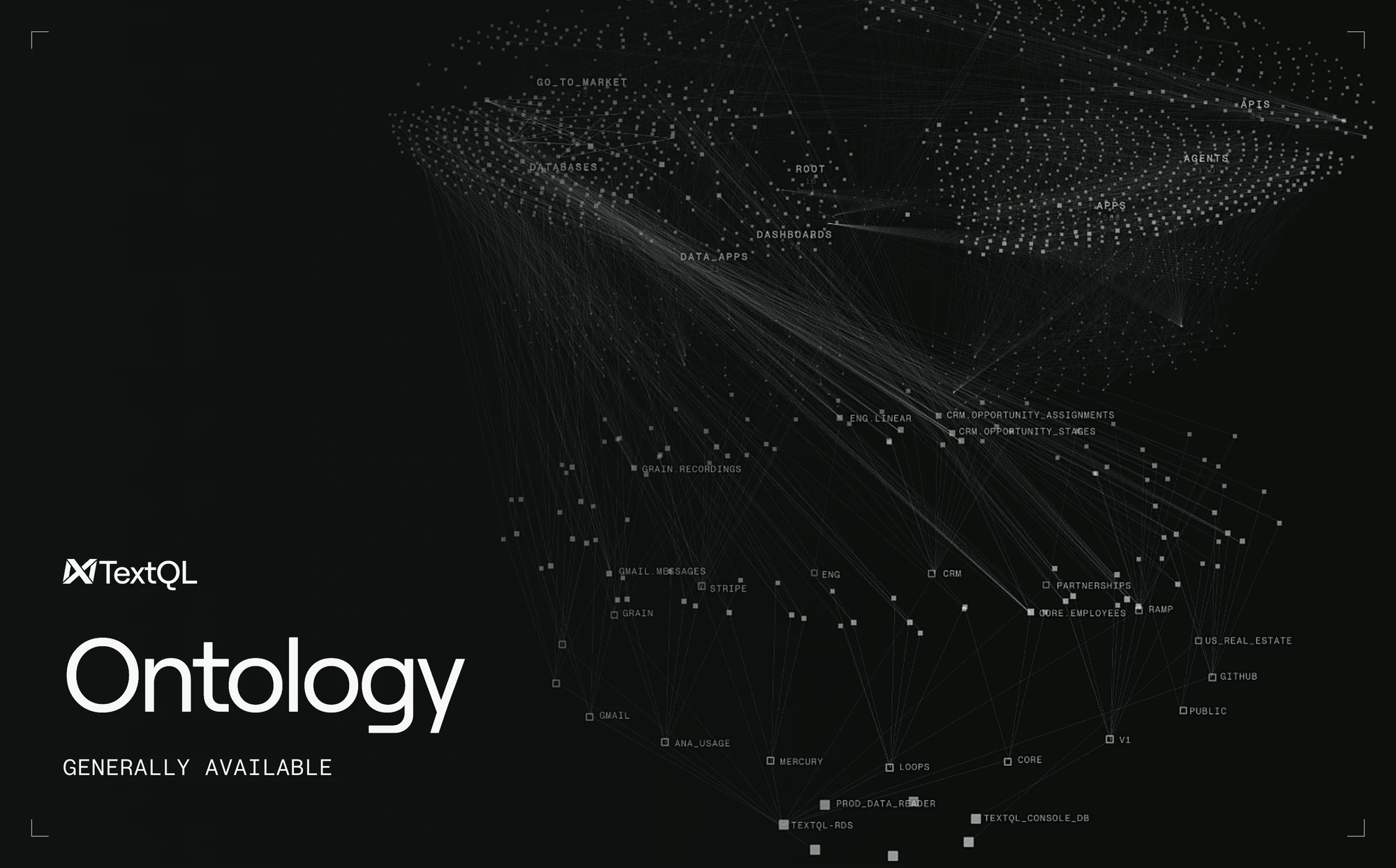
TextQL combines an AI agent with a purpose-built warehouse that runs inside a customer's private environment. Instead of relying on pre-modeled schemas or manually curated semantics, TextQL automatically maps relationships across disparate datasets to create a shared, business‑friendly knowledge layer. This enables its AI agent to reason over raw, messy enterprise data with deterministic, auditable accuracy.
It's not a layer on top of existing systems, and it doesn't require years of migration or schema design. The result is exploratory analysis that runs orders of magnitude faster and works across full enterprise datasets, including messy, uncleaned data that would normally require months of preparation, without weeks of configuration.
With this context layer in place, TextQL's agent can autonomously execute multi‑step analysis, generate visualizations, schedule reports, reconcile data, and perform transformations end to end — with the goal of producing accurate, verifiable results without manual intervention.
In Production Today
TextQL is already running in production at companies like Amazon and Dropbox, as well as large enterprises across healthcare, financial services, real estate, and technology. About half of our production workloads run on-premise or inside customer VPCs — environments where security, latency, and reliability matter far more than demos.
That real-world usage is what led to this next chapter.
The Investment
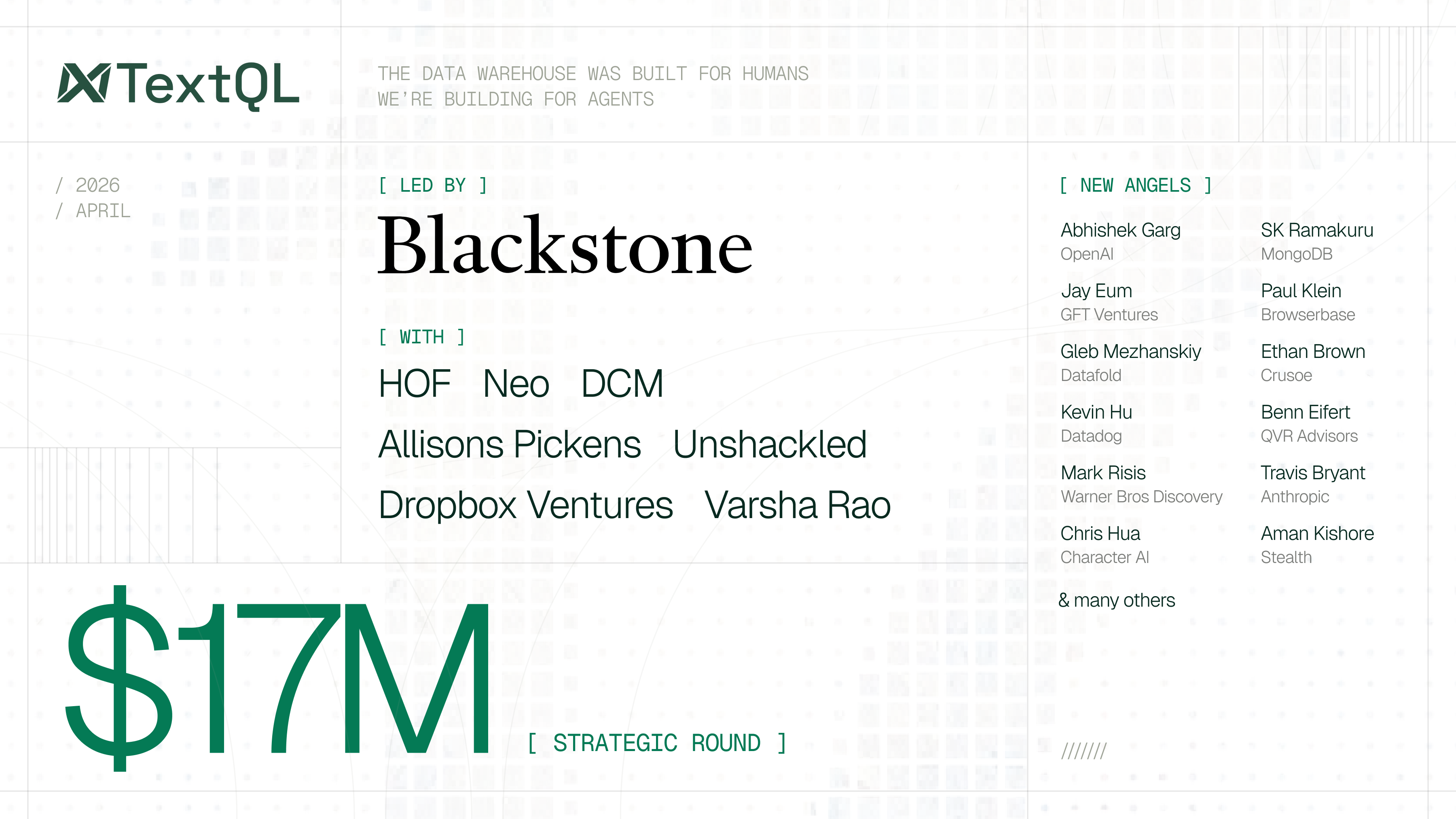
We have closed $17M in strategic investment anchored by Blackstone Innovations Investments (BXII), Blackstone's early-stage investment arm. Blackstone has more than $1 trillion in assets under management and operates some of the most complex data environments in the world. The firm evaluates many AI‑for‑finance technologies each year and only a few meet the criteria to advance beyond POC into production.
Blackstone's decision to invest followed hands-on testing of TextQL's capabilities in real operational environments. Blackstone's technology leadership evaluated whether TextQL's architecture could deliver meaningful time-to-value—without requiring lengthy data consolidation projects or major system migrations. That evaluation aligned with how Blackstone approaches enterprise technology more broadly: AI is only as effective as the infrastructure underneath it. Blackstone's CTO, John Stecher, described TextQL as "one of the fastest time-to-value he's seen for AI operating over complex enterprise data".

"When I take a number, I feel confident that I can bring it in front of a CFO and know it's been vetted by TextQL."
What's Next
We're focused on building infrastructure that captures what a company's best analysts already know and makes it usable faster, more consistently, and at a far greater scale. Analysis that once took months can now happen in weeks, days, or even hours.
The funding helps us move faster, but the direction hasn't changed. Enterprises are done trying to force AI into systems that were never designed for it. They want a data warehouse that assumes AI agents are first-class actors.
We've been building this from the beginning. Now we scale it.
— Ethan Ding Co-founder & CEO, TextQL